
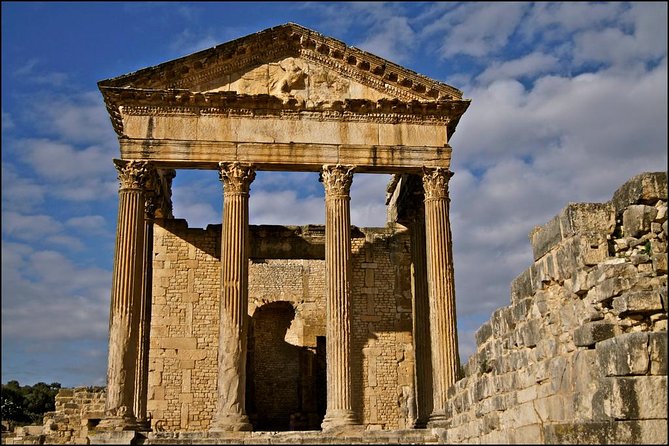
Reviewed · DOUGGA
Private Day Tour Dougga
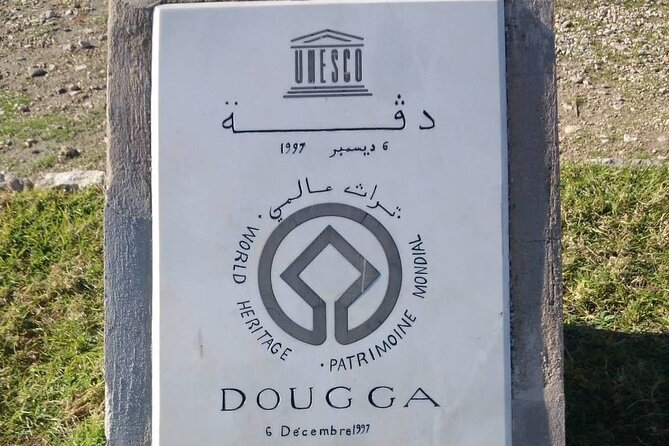
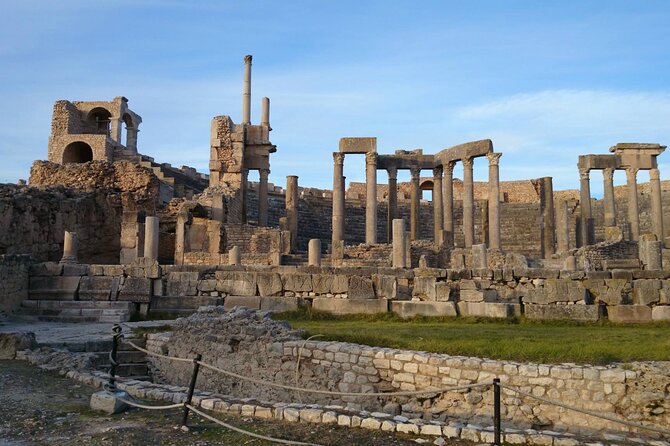
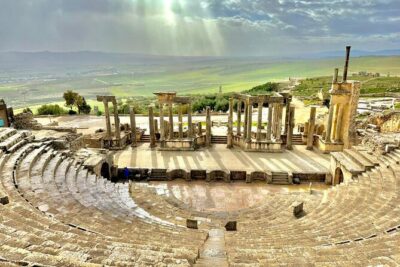
Dougga is not a quick photo stop. This 185-acre UNESCO archaeological site spreads across a hilltop, with Roman temples, theaters, baths, and older North African remains scattered over a wide area. A private guide helps you make sense of it instead of wandering from ruin to ruin without a plan.
I like the private format for two reasons: you can explore at your own pace, and the guide can focus on the history that interests you most. I also like the option to add the Medjez-El-Bab War Cemetery, which gives the day a more recent historical layer. The main drawback is that the tour lasts about seven hours, with roughly three hours at Dougga, and the entrance fee is extra.
Key details before you reserve
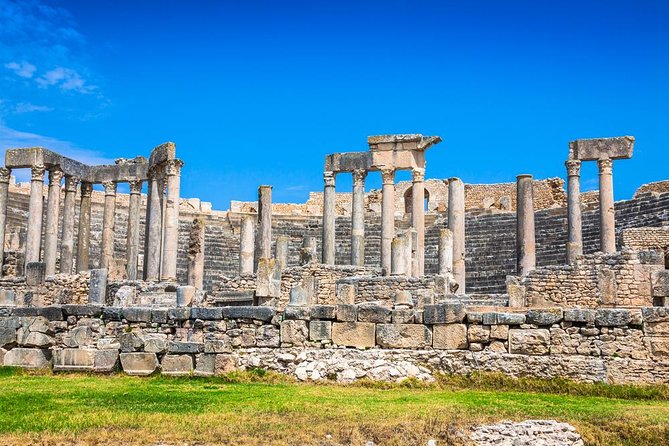
- Dougga covers about 185 acres: Wear sensible shoes and expect a lot of walking between widely spaced ruins.
- A private guide leads the visit: Noureddine Boukari, also referred to as Boukka, is associated with the tour and is praised for his explanations of Phoenician and Roman history.
- Pickup is available from Tunis or Hammamet: This saves you from arranging separate transport to a remote archaeological site.
- The main site visit lasts about three hours: That is enough for the major monuments, though the size of Dougga means you will not examine every corner.
- The Medjez-El-Bab cemetery is optional: You can request this additional stop for a different look at Tunisia’s 20th-century past.
- The price is $236.02 per group of up to three: Private transport and a licensed guide are included, but Dougga admission costs 5 euros per person.
Why Dougga deserves a full day from Tunis
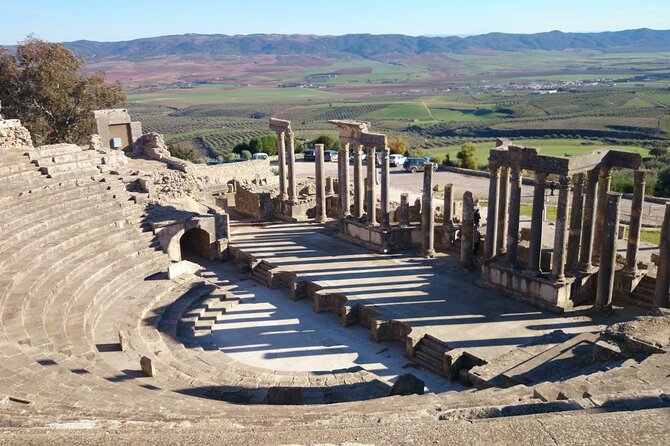
Dougga is one of North Africa’s finest Roman archaeological sites, but its appeal goes beyond Roman ruins. The city also preserves evidence of earlier Numidian and Phoenician life, so you are looking at several layers of Tunisian history in one place.
The site sits on a hill and spreads across open countryside. That setting gives Dougga a strong sense of place. You are not moving through a compact city center where one monument quickly gives way to another. Instead, you walk between structures that are separated by space, with the remains arranged across the old settlement.
That size is both the pleasure and the challenge. You have room to look closely and take in the setting, but it can be difficult to know where to begin. A guide is especially useful here because the best route is not obvious from the entrance.
With a private visit, you can pause at the monuments that interest you. If Roman engineering is your priority, you can spend more time on the theater, temples, and public buildings. If you are more interested in Tunisia before Rome, you can ask for greater attention to the earlier cultural layers.
More Private Tours in Tunis
- Private Tour to Kairouan, El Jem & Monastir from Tunis_hammamet
★ 5.0 · 301 reviews - Private tour: Medina,Carthage ,Sidi Bou Said, Bardo Museum+lunch
★ 5.0 · 230 reviews - Carthage, Bardo Museum, Sidi Bou Said and Medina Private Day Tour
★ 4.5 · 153 reviews
Leaving Tunis or Hammamet at 8:30 a.m.
The scheduled start time is 8:30 a.m., with pickup from your hotel in Tunis or Hammamet. Private transportation is included, so you do not need to find your own way to Dougga or join a large coach group.
That pickup arrangement is one of the tour’s most useful features. Dougga is not the kind of place you casually visit while walking around central Tunis. Having a vehicle and driver arranged for you makes the day simpler, especially if you are traveling as a small group of two or three people.
The tour is private, meaning only your group participates. This matters more than it might on a short city walk. You can ask questions in the car, discuss how much time you want at each part of the site, and avoid waiting for a large group to gather.
The drive itself is not described in detail, so do not book this expecting a planned series of roadside stops. The focus is Dougga. Think of the transportation as a practical way to reach the archaeological site, not as a separate sightseeing program.
Entering Dougga’s 75 hectares
The first important thing to understand is scale. Dougga covers about 75 hectares, or 185 acres. Three hours gives you a useful visit, but it is not enough to study every building in detail.
A guide helps you use that time well. Rather than trying to cover the entire site at random, you can go directly to the main points and learn why they matter. The tour is designed around highlights, which is sensible for a day trip from Tunis or Hammamet.
You should expect walking over uneven ground and across open areas. The tour asks for a moderate level of physical fitness, and that is worth taking seriously. Even if you are not a serious hiker, you should be comfortable walking for several hours around a large archaeological site.
Bring practical clothing and footwear. The supplied information does not specify shade, seating, or facilities at each part of the site, so plan for an outdoor visit rather than a museum-style experience. The most useful extras are water, sun protection, and shoes with a firm sole.
The Roman theater and public buildings
The Roman character of Dougga is one of the main reasons people make the trip. The site is often described as one of the best Roman sites in North Africa, and its wide collection of public buildings gives you a clear sense of how an ancient city functioned.
Your guide can explain the purpose of the major structures rather than leaving you with a collection of impressive but disconnected stones. That context is valuable at Dougga because the site is so large. A temple may look beautiful on its own, but its role in the old city becomes clearer when it is connected to public life, religious practice, and Roman urban planning.
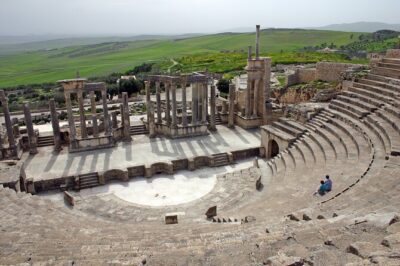
The theater is among the parts many people want to see, but the tour information does not promise a fixed monument-by-monument route. That is actually useful in a private setting. You can ask to spend more time at the Roman features you find most interesting rather than following a rigid schedule.
The guide associated with this experience is Noureddine Boukari, also called Boukka. His explanations are praised for covering Phoenician and Roman history, as well as Tunisian culture, art, political science, and more recent events. That range can turn a simple site visit into a broader conversation about how Tunisia developed over time.
More Roman site days around Tunis:
- Private Excursion to Testour, Dougga and Bulla Regia from Tunis.
★ 5.0 · 100 reviews - Full Day Dougga & Bulla Regia Via Testour Private tour with Lunch
★ 5.0 · 29 reviews - Private Guided Tour of Dougga and Testour Mosque
★ 4.5 · 15 reviews - Dougga and Bulla Regia Guided Tour From Tunis
★ 4.5 · 11 reviews
Earlier history beneath the Roman city
Dougga should not be reduced to a Roman-only stop. The guide’s background in Phoenician and Roman history is particularly useful because it gives you a way to understand the site before and after Roman rule.
You may find that the most rewarding part of the visit is the connection between the different periods. Ruins are not just isolated Roman buildings. They form part of a longer story about North Africa, local traditions, outside powers, and the changing role of the city.
This is where a private guide can offer more than a standard audio guide. You can ask what came before Rome, how local culture fit into the Roman world, and what later generations did with the site. The information provided does not promise a specialist archaeological lecture, so expectations should remain practical. You are booking a guided overview with room for questions, not a university seminar.
Still, the guide’s enthusiasm for Tunisian history is one of the strongest reasons to choose this experience. The guide’s explanations are described as detailed and engaging, with attention not only to ancient history but also to modern Tunisia. That broader view helps you connect Dougga to the country you are visiting today.
A possible second stop at Medjez-El-Bab
On request, the tour can include the Medjez-El-Bab WWII cemetery. This is not part of the basic Dougga stop unless you arrange it, so ask about it before the day begins.
The cemetery offers a different kind of historical experience. Dougga takes you back to ancient North Africa and the Roman period. Medjez-El-Bab relates to the Second World War and the people who died during that conflict. Placing both stops in one day creates a striking contrast between Tunisia’s ancient past and its modern wartime history.
The available information does not give a separate duration for the cemetery or confirm any additional cost. Because the tour is listed at about seven hours and the Dougga visit takes around three hours, you should clarify how the optional stop affects the schedule.
I would add it if you have a strong interest in military history or want a day with more than one historical focus. If Dougga is your main reason for booking, keep the cemetery optional so the extra stop does not make the day feel rushed.
What private touring changes
The private format is the heart of this experience. You are not sharing the guide with a busload of people, and only your own group participates.
That gives you control over the pace. You can stop for photographs, ask for a simpler explanation, or request more detail about a particular period. If one member of your group is fascinated by ancient religion while another wants to hear about modern Tunisia, the guide can adjust the conversation.
The format also suits families, couples, and small groups of friends who prefer not to follow a fixed public tour. A group of up to three is covered by the quoted price, so the value improves when two or three people share the vehicle and guide.
There is one tradeoff. Private touring does not automatically mean unlimited time. The experience lasts about seven hours, and the Dougga portion is listed at about three hours. You gain flexibility within the visit, but you should not assume the guide can turn this into an all-day archaeological study.
Is $236.02 good value?
The listed cost is $236.02 per group of up to three people. That works out to about $78.67 each for three people, or about $118.01 each for two people, before the entrance fee.
For that price, you receive private transportation and a licensed tour guide. Pickup and drop-off are offered from hotels in selected cities, specifically Tunis and Hammamet in the tour details. That combination makes the price easier to justify than a simple guided walk because transportation to Dougga is included.
The value is strongest for three people. A solo visitor pays the full group rate, which makes the tour more expensive per person than it is for a small group. If you are traveling alone, compare the convenience of private pickup and one-on-one guiding with the cost of arranging transport separately.
Dougga admission is not included. The stated entrance cost is 5 euros per person, and the information also repeats that an entrance fee is required, so budget for this separately. The optional Medjez-El-Bab stop may need its own confirmation regarding timing and cost.
I see this as a convenience-focused tour rather than the cheapest way to reach Dougga. You are paying for a private vehicle, a licensed guide, a flexible visit, and less planning work. For a small group that values those points, the price is reasonable. For a solo budget traveler, it is a bigger commitment.
What to know about the guide
The experience is provided by Noureddine Boukari. The guide is also referred to as Boukka in the tour material, so you may see either name associated with the experience.
The strongest praise centers on his historical explanations and enthusiasm. He is described as having extensive expertise in Phoenician and Roman history, along with a strong interest in Tunisian history, culture, art, political science, and recent events.
That matters because Dougga can be read in two ways. You can treat it as a collection of Roman monuments, or you can use it as a starting point for understanding Tunisia. A guide who can move between ancient history and modern culture gives the site more meaning without requiring you to arrange separate tours.
The guide’s personal approach also suits people who like conversation. The private format gives you the chance to ask questions instead of simply listening to a set speech. If you want a quiet visit with minimal explanation, this may be more guidance than you need. If you want context, it is a major benefit.
Timing, fitness, and practical preparation
The tour begins at 8:30 a.m. and lasts about seven hours. That makes it a substantial day trip, not a brief morning outing.
The site visit itself is around three hours. Since Dougga is spread over 185 acres, you should expect walking between monuments rather than seeing everything from one central path. A moderate physical fitness level is required.
The tour offers a mobile ticket and confirmation is provided at booking. The important cost to remember is the 5 euro Dougga admission per person, which is not included in the tour price.
Free cancellation is available if you cancel at least 24 hours before the start time. Cancellations made less than 24 hours before the tour are not refunded, and changes within that period are not accepted. The cut-off follows local Tunisian time.
Who will enjoy this Dougga tour most?
I would recommend it most strongly to people staying in Tunis or Hammamet who want to see Dougga without arranging private transport on their own.
It is also a good fit for:
- Small groups of two or three who can share the group price
- History-minded visitors who want both Roman and Phoenician context
- People who prefer a private pace over a large organized group
- Visitors interested in connecting ancient sites with modern Tunisian culture
- Anyone who wants the choice of adding a WWII cemetery
You may want to think twice if you are traveling alone on a tight budget, dislike several hours of walking, or want a very long and highly specialized archaeological study. The tour gives you a strong overview and personal guidance, but the three-hour site visit places a natural limit on how much you can see.
Should you book the private Dougga day tour?
Book it if you want Dougga to be the main event of your day and value an expert-led visit, hotel pickup, and private transportation. The large site is easier to understand with a guide, and the private format lets you set the pace within the seven-hour schedule.
I would especially choose it for a group of three. That is where the $236.02 price makes the most sense. Add the Medjez-El-Bab cemetery if modern military history interests you, but confirm how it fits into the day.
Skip it if you only want the lowest-cost route to Dougga or if three hours of walking around a broad archaeological site sounds tiring. For most small groups staying in Tunis or Hammamet, though, this is a practical way to see one of Tunisia’s major ancient sites without losing time to transport planning.
FAQ
Where does the private Dougga tour depart from?
Pickup is offered from hotels in Tunis or Hammamet. The listed start time is 8:30 a.m.
How long does the experience last?
The full tour lasts approximately seven hours. The Dougga visit itself is listed as about three hours.
Is Dougga admission included in the tour price?
No. Entrance to Dougga costs 5 euros per person and is paid separately.
How many people can join the private tour?
The quoted price of $236.02 covers one private group of up to three people. Only your group participates.
What is included?
Private transportation and a licensed tour guide are included. Pickup and drop-off are offered from selected hotels in Tunis or Hammamet.
Can I visit the Medjez-El-Bab WWII cemetery?
Yes. You can request a stop at the Medjez-El-Bab WWII cemetery. The stop is optional, and you should ask how it affects the schedule.
What happens if I need to cancel?
You can receive a full refund if you cancel at least 24 hours before the experience starts. Cancellations or changes made less than 24 hours before the start time are not accepted, and the amount paid is not refunded.
Just added around Tunis
- Private Group Day Tour Tunis Medina Carthage Sidi Bou Said★ 4.5 · 3 reviews
- Private Tour Bardo Museum, Carthage, Sidi Bou Said and Medina★ 4.5 · 3 reviews
- Explore Tunisia in Depth:The Private Grand Tour in 8 Days★ 5.0 · 3 reviews
- 3-Day South of Tunisia Guided Tour from Tunis★ 4.0 · 3 reviews
- Bardo Museum , Oudhna and the roman aqueduct★ 5.0 · 4 reviews
- From Tunis: Star Wars 5 day tour★ 5.0 · 4 reviews
- DAY TRIP TO Dougga & Bulla Regia , DEPARTURE FROM Tunis★ 5.0 · 4 reviews
- Private Walking Tour of Carthage Archaeological Site in Tunisia★ 4.5 · 4 reviews
Dougga & Bulla Regia Roman Sites, compared.
Private Excursion to Testour, Dougga and Bulla Regia from Tunis.
Read our review →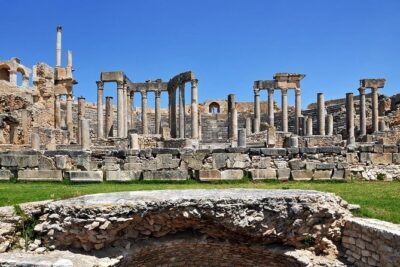
Full Day Dougga & Bulla Regia Via Testour Private tour with Lunch
Read our review →
Private Day Trip to Testour, Dougga and Bulla Regia from Hammamet
Read our review →
Private Guided Tour of Dougga and Testour Mosque
Read our review →
Bulla Regia and Beni Mtir Cascade Daytrip from Tunis
Read our review →
DAY TRIP TO Dougga & Bulla Regia , DEPARTURE FROM Tunis
Read our review →Browse the lists this tour appears in