
Reviewed · EL JEM
Private Tour to Kairouan, El Jem & Monastir from Tunis_hammamet
Kairouan’s Great Mosque and El Jem’s Roman amphitheater give this day trip its real punch. You move from the spiritual center of medieval North Africa to one of the largest surviving Roman arenas, then finish beside Monastir’s sea-facing Ribat.
I like the private vehicle and guide, which make a long day easier and allow some flexibility. I also like that the entrance fees are included, including the often-missed Aghlabid basins. The main drawback is simple: this is a packed 8 to 10 hours, with plenty of time in the car and only about 20 to 40 minutes at several sights.
Key points to know before booking
- Three major sites in one day: Kairouan, El Jem, and Monastir form a demanding but rewarding southbound circuit.
- The Great Mosque is the morning anchor: Its courtyard, minaret, cedar doors, and marble columns are the day’s most important religious sight.
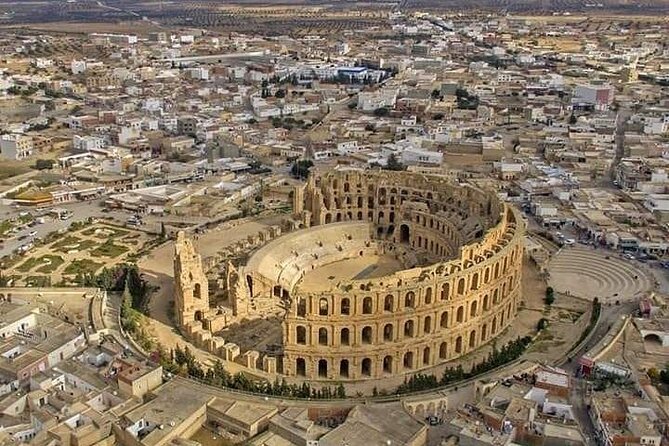
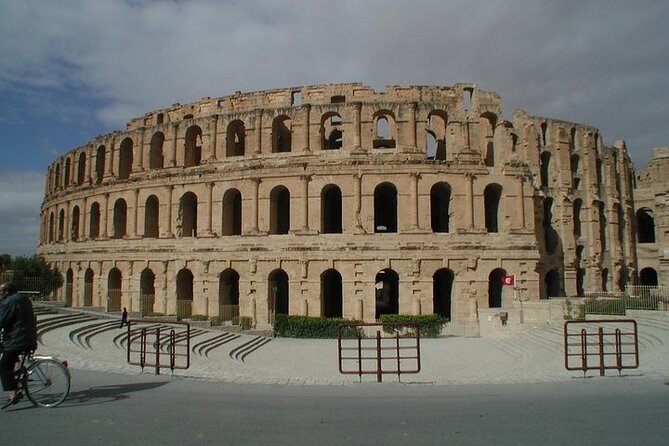
- El Jem is the visual showstopper: The third-largest Roman amphitheater in the ancient world could hold about 30,000 spectators.
- A private format helps: Your group travels alone, with hotel pickup, an air-conditioned vehicle, a driver, and a professional guide.
- Lunch costs extra: Plan for a meal stop, but do not expect lunch to be part of the $98.48 price.
- Ask about shopping: Kairouan’s carpets and pastries are tempting, but avoid pressure to buy and request clear information about authenticity.
Why this Tunisian day trip works
At $98.48 per person, this tour offers a practical way to connect three places that are awkward to cover independently in one day. You get transport, a guide, hotel pickup, and admission to five listed sights. For a couple or small group, that can be fair value, especially if you are staying in Tunis or Hammamet and do not want to arrange several separate rides.
The route is also well chosen. Kairouan gives you Islamic architecture and traditional crafts. El Jem brings Roman engineering on a huge scale. Monastir adds a coastal fortress and views over the city and sea. These are not three versions of the same stop.
The tradeoff is time. The advertised duration is 8 to 10 hours, and the sites are spread across a broad triangle south of Tunis. You will spend several hours in the vehicle. That is not a flaw in the route, but you should know what kind of day you are buying: a fast historical circuit, not a slow stay in each town.
The private setup is especially useful for families, couples, and small groups with limited time. The vehicle is air-conditioned, and the driver matters here as much as the guide because of the distance. Past guides named in strong feedback include Yaya, Kimos, Bilel, Bilal, Ahmed, Beligh, Balagh, Chaouki, and Caulios. Your assigned guide may be different, but these names give you an idea of the range of guides used on the experience.
More Private Tours in Tunis
- Private tour: Medina,Carthage ,Sidi Bou Said, Bardo Museum+lunch
★ 5.0 · 230 reviews - Carthage, Bardo Museum, Sidi Bou Said and Medina Private Day Tour
★ 4.5 · 153 reviews - Private Excursion to Testour, Dougga and Bulla Regia from Tunis.
★ 5.0 · 100 reviews
Kairouan’s Great Mosque and its fortress-like design
Your first major stop is the Great Mosque of Kairouan, founded in 670. It is the city’s defining monument and one of the oldest religious buildings in the Muslim West.
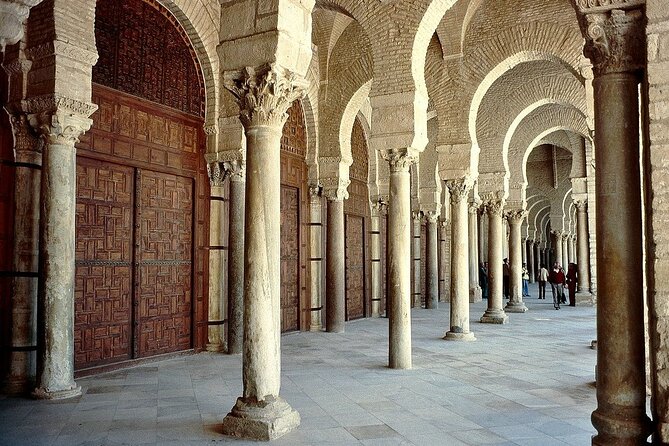
The building has the look of a fortified adobe structure. That is part of its appeal. Rather than presenting a delicate palace façade, it feels weighty, enclosed, and built for permanence. The large courtyard is framed by carefully arranged arcades, with a sundial set within the open space.
Look closely at the doors. The cedar wood is richly carved, and the details reward a slower glance. Inside, the prayer rooms contain rows of marble columns, giving the interior a sense of depth and order. The mosque’s design influenced later mosques across the Maghreb, so this is more than a beautiful stop. It helps you read the architecture you will encounter elsewhere in Tunisia and North Africa.
The visit is scheduled for about 40 minutes, with admission included. That is enough for an introduction and a close look at the main features, but not enough for an unhurried architectural study. Wear shoes that are easy to manage and dress respectfully for a major religious site. The supplied details do not state the exact rules for entering every interior area, so your guide will be the best source of current instructions.
Kairouan’s medina, pastries, and carpet stalls
After the mosque, you get around 30 minutes in Kairouan’s medina. This is short, so use the time with a plan rather than wandering without direction.
The medina is known for its preserved streets, souks, traditional crafts, and carpet making. You may also want to try makroud, the local pastry made with semolina and dates. It is one of Kairouan’s most familiar specialties and an easy edible souvenir.
Carpet shopping requires more care. A guide may take you toward a carpet shop, and browsing can be interesting, but you should not feel obliged to purchase. One serious complaint about the experience involved carpets presented as authentic and official, which were later judged false by an expert. That is a clear reason to ask direct questions about origin, certification, materials, return terms, and whether the seller is connected to any government body.
I would treat the medina as a cultural stop first and a shopping stop second. If you want a carpet, take your time, compare prices, and do not buy simply because a sales pitch says the opportunity is rare. The tour provider stated that one guide involved in the complaint was an independent guide rather than a company employee, but the practical lesson for you remains the same: protect your own purchase decision.
The Aghlabid basins, Kairouan’s impressive waterworks
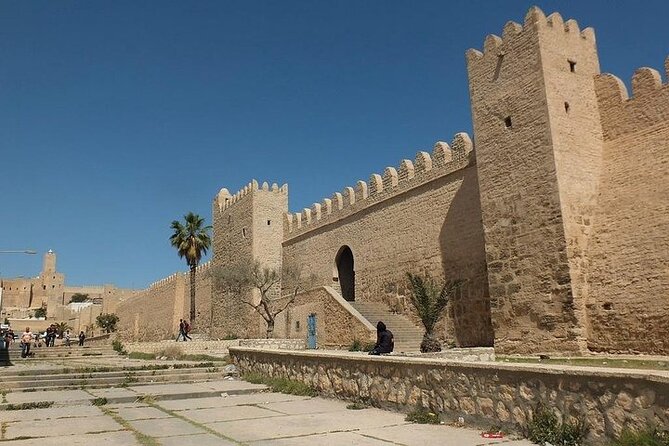
The Aghlabid basins receive about 20 minutes and are located outside the medina walls. They date from the beginning of the second half of the ninth century and are described as among the most important hydraulic works in the Muslim world.
These broad water reservoirs show how much planning was needed to support Kairouan. The mosque and medina tell you about faith, learning, trade, and daily life. The basins show the practical systems behind the city’s growth.
This is a quieter stop, and some visitors may find it less immediately dramatic than the mosque or amphitheater. Still, I would keep it in the schedule. It adds useful context and takes little time. Your guide can explain how the basins fit into Kairouan’s development, turning what might look like a simple open space into an important piece of the city’s story.
More El Jem amphitheatre trips:
- Daytrip to Kairouan and El Jem Colosseum
★ 4.5 · 55 reviews - Kairouan and El Jem Private Day Tour
★ 4.5 · 38 reviews - Private Day Tour , Kairouan & Amphitheatre of el Jem From Tunis /Hammamet/Sousse
★ 4.5 · 8 reviews - El Jem and Monastir Full-Day Tour with Lunch from Tunis or Hammamet
★ 4.5 · 7 reviews
El Jem, where the Roman arena takes over the day
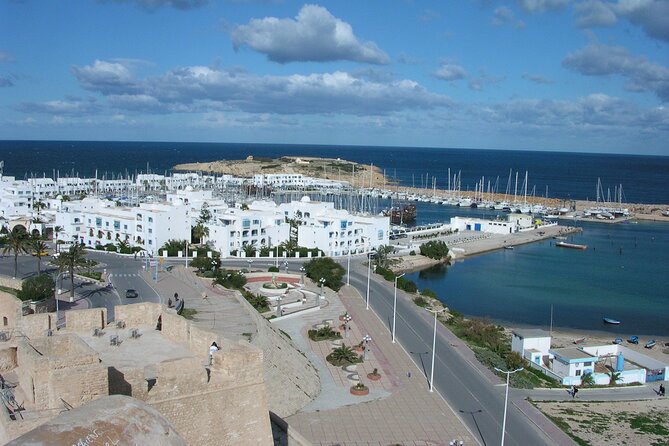
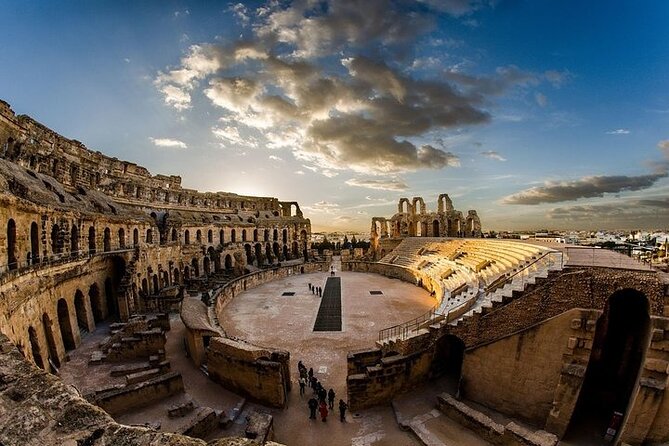
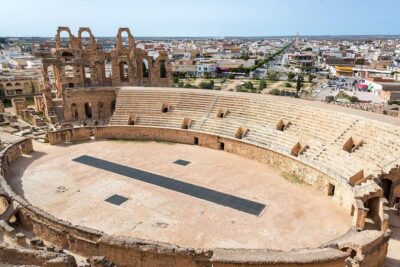
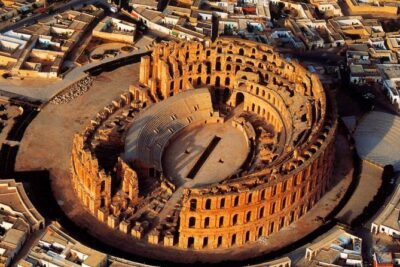
El Jem is the strongest reason many people choose this tour. The ancient city was known as Thysdrus and became one of the most prosperous Roman cities in Africa. Its amphitheater was built in the third century AD and could hold about 30,000 spectators.
The scale is hard to grasp from photographs. Inside, you can look across the arena and then down toward the underground structures beneath it. The combination of open seating, corridors, and below-ground spaces makes the building feel more complete than many Roman ruins.
The amphitheater is often compared with the Colosseum in Rome and the arena at Capua. It is described as third in size in the Roman world after those two. That comparison is useful, but El Jem has its own setting and character. You are seeing Roman public architecture in North Africa, not simply a smaller copy of Rome.
Admission is included, and the planned visit lasts about 40 minutes. That gives you time to see the arena and underground areas, but the site can easily absorb more time if you enjoy photography or ancient engineering. Ask your guide to point out how spectators, performers, animals, and service workers moved through the building.
The day’s schedule may not allow a long museum visit or a slow circuit around every passage. Even so, El Jem is the place where the short visit feels most worthwhile. If you must choose one stop to study closely, this is a good candidate.
Monastir’s Ribat and its coastal view
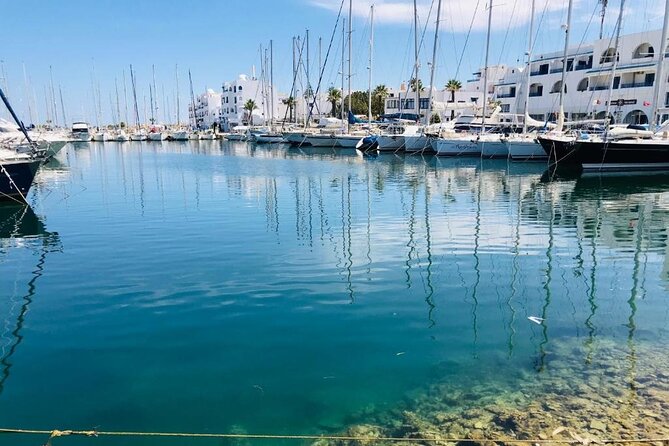
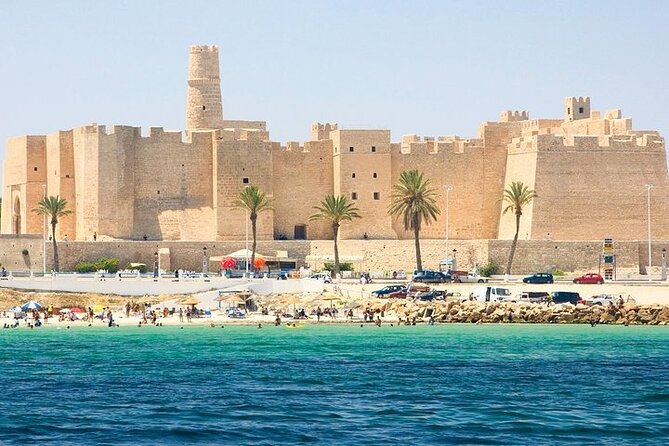
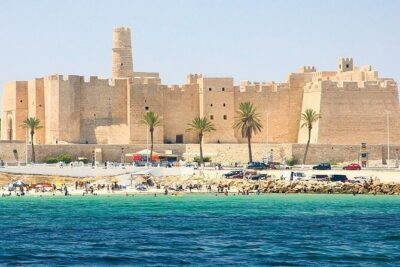
The final major stop is the Ribat of Monastir, founded in 796. It was built as a defensive work along the Maghreb coast and later changed through medieval renovations.
The structure began as a quadrilateral complex with four main buildings opening onto two courtyards. Its small cells housed warrior monks who combined military duties with prayer and contemplation. The Ribat also contains prayer rooms and a collection of religious and medieval craft objects.
The most rewarding feature may be the watchtower. About one hundred spiral steps lead upward. From the top, you get a view across Monastir and toward the sea. After a full day in the vehicle, this change of pace is welcome, though the climb may not suit everyone.
The visit is scheduled for roughly 40 minutes. If you want the tower view, do not spend all your time in the lower rooms. The guide can help you decide how to divide the visit between the courtyards, prayer spaces, exhibits, and stairs.
Monastir was once known as the Punic and Roman city of Ruspina, adding another layer to the day’s long timeline. Kairouan focuses on Islamic tradition, El Jem on Roman power, and Monastir combines coastal defense with later religious history.
The long drives and how the private format helps
This is not a compact walking tour. The three destinations are spread out, and the driving is a large part of the experience. Some visitors have praised careful drivers and comfortable vehicles, while one poor experience involved a flat tire and concern about vehicle maintenance. The provider responded that its vehicles receive regular checks, but it is still sensible to confirm pickup details and vehicle arrangements before leaving.
The private format gives you more control than a large coach tour. You can ask for explanations, request a brief pause when appropriate, and discuss the lunch stop with your guide. The exact schedule remains important, since the tour has several fixed visits and must return within the stated 8 to 10 hour window.
Guides have been praised for being friendly, flexible, multilingual, and willing to adjust the day. One guide joined a solo customer for lunch so the person would not have to eat alone. Another helped a group keep seeing the main sights when one location closed early. These examples suggest that a good guide can make a tight schedule feel far less mechanical.
Still, do not assume every guide will offer the same style. Ask questions early. If you care most about architecture, shopping, photography, or Tunisian culture, say so at pickup. A private guide can respond to your interests much better when you explain them clearly.
Food, timing, and what to bring
Lunch is not included, so budget separately. The supplied details do not name a specific restaurant or set menu. Your guide may suggest a place, and you can discuss preferences before the meal stop.
Bring water, sun protection, and comfortable shoes. You will walk through historic courtyards, a medina, an amphitheater, and a fortified complex with a spiral stairway. The day can feel hot and tiring even when the vehicle is air-conditioned.
The tour requires good weather. If poor weather forces cancellation, you are offered another date or a full refund. You can cancel for a full refund up to 24 hours before the start time, while changes or cancellations inside that 24-hour window are not accepted.
Hotel pickup is offered from the Tunis and Hammamet area named in the tour title. Confirmation is provided at booking, and the experience is described as suitable for most participants. Service animals are allowed, and the tour is near public transportation, though the main experience itself is carried out by private vehicle.
Who should book this Kairouan, El Jem, and Monastir tour?
I would book it if you are staying in Tunis or Hammamet and want to see several major historic sites without arranging intercity transport yourself. It is especially useful if you have only one free day and value an informed guide more than long free time at each site.
It suits couples, families, and small groups who want their own vehicle and a more personal day. Solo customers can also benefit from the private setup, particularly if they prefer company during the long route and lunch stop.
I would think twice if you dislike long drives, want a relaxed pace, or hope to spend hours shopping in Kairouan. The schedule is efficient, not leisurely. The mosque and El Jem deserve more time than the timetable provides, so serious history fans may prefer a longer, slower arrangement.
At 96 percent recommended and a 4.8 rating from 301 ratings, the overall record is strong, but the carpet complaint and vehicle issue are important reminders to stay alert. Confirm who will guide you, ask about the lunch plan, and be cautious with any purchase presented as officially certified.
Should you book it?
Book this tour if you want maximum historical variety in one day and accept several hours on the road. Kairouan’s Great Mosque, El Jem’s enormous arena, and Monastir’s Ribat each offer something different, and the included transport and admissions make the price reasonable for a private experience.
Skip it if you need a slow holiday day or cannot manage the walking and stairs. For most first-time visitors with limited time in Tunisia, though, this is a smart route, provided you set realistic expectations and keep shopping decisions firmly in your own hands.
FAQ
How long does the tour last?
The experience lasts approximately 8 to 10 hours.
Where does the tour depart from?
Pickup is offered from hotels in the Tunis and Hammamet area named in the tour title.
Is this a private tour?
Yes. Only your group participates in the private activity.
What is included in the price?
The price includes GST, a certified professional tourist guide, an air-conditioned vehicle, hotel pickup, and entrance fees for the Great Mosque of Kairouan, the Medina of Kairouan, El Jem amphitheater, Monastir Ribat, and the Aghlabid basins.
Is lunch included?
No. Lunch is not included.
How much does the tour cost?
The listed price is $98.48 per person.
Are entrance tickets included?
Yes. Admission is included for all five listed attractions.
Can I cancel for a full refund?
Yes. You can cancel at least 24 hours before the experience starts for a full refund. Cancellations or changes made less than 24 hours before the start time are not accepted for a refund.
More Kairouan Days Out
- Daytrip 3 Unesco Sites El Jem Kairouan and Sousse Medina
★ 5.0 · 7 reviews - Full-Day Kairouan and El Jem Tour from Tunis
★ 4.0 · 7 reviews - Kairouan & El Jem Small Group Tour from Tunis, Hammamet or Sousse
★ 5.0 · 6 reviews - El Jem, Monastir, and Kairouan Medina Private Tour
★ 5.0 · 5 reviews
Just added around Tunis
- Private Group Day Tour Tunis Medina Carthage Sidi Bou Said★ 4.5 · 3 reviews
- Private Tour Bardo Museum, Carthage, Sidi Bou Said and Medina★ 4.5 · 3 reviews
- Explore Tunisia in Depth:The Private Grand Tour in 8 Days★ 5.0 · 3 reviews
- 3-Day South of Tunisia Guided Tour from Tunis★ 4.0 · 3 reviews
- Bardo Museum , Oudhna and the roman aqueduct★ 5.0 · 4 reviews
- From Tunis: Star Wars 5 day tour★ 5.0 · 4 reviews
- DAY TRIP TO Dougga & Bulla Regia , DEPARTURE FROM Tunis★ 5.0 · 4 reviews
- Private Walking Tour of Carthage Archaeological Site in Tunisia★ 4.5 · 4 reviews
El Jem Amphitheatre Tours, compared.
Fun VIP Tour: El Jem, Kairouan, Monastir/Sousse
Read our review →
Half-day excursion from Sousse to the amphitheater of El Jem
Read our review →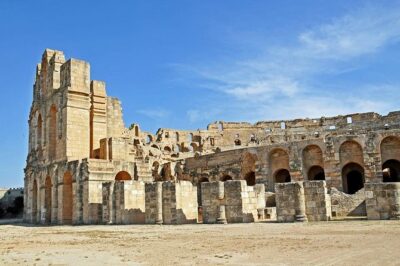
Private and Guided Tour to Kairouan and El Jem and Monastir
Read our review →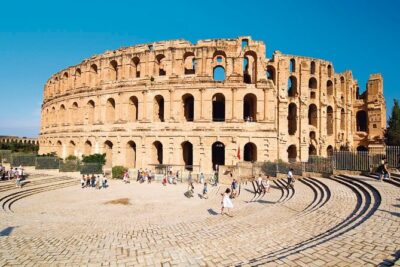
Kairouan Holy City and El Jem Colosseum Tour from Sousse
Read our review →Private Day Tour , Kairouan & Amphitheatre of el Jem From Tunis /Hammamet/Sousse
Read our review →Browse the lists this tour appears in