
Reviewed · DOUGGA
Private Excursion to Testour, Dougga and Bulla Regia from Tunis.
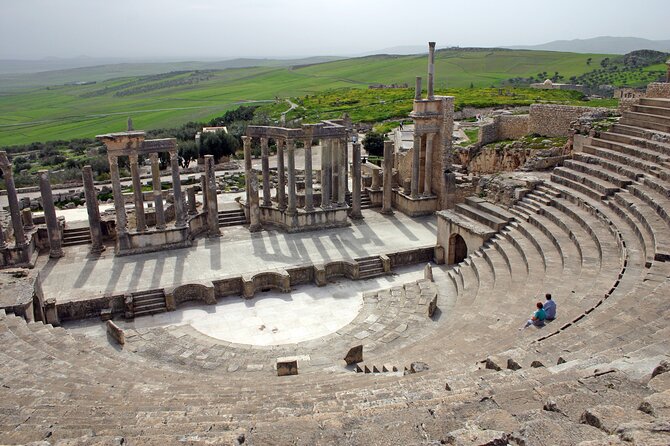
Dougga is the star here: a remarkably complete Roman town spread across a hilltop, with a theater, Capitol, baths, forum, mausoleum, and wide views over northern Tunisia. At Bulla Regia, the surprise comes underground, where Roman villas were built below the hot sun. Testour adds a small but unusual Andalusian chapter.
I like the private format, which lets your group set the pace, and I like the chance to see two major ancient sites in one long day. The main catch is time: Testour can feel like a quick photo stop, and Dougga’s steep, uneven paths require steady walking.
Key points at a glance
- Dougga gets about three hours, enough to see its major monuments without treating the site like a rushed roadside stop.
- Bulla Regia offers a different Roman experience, with underground houses and well-preserved mosaics.
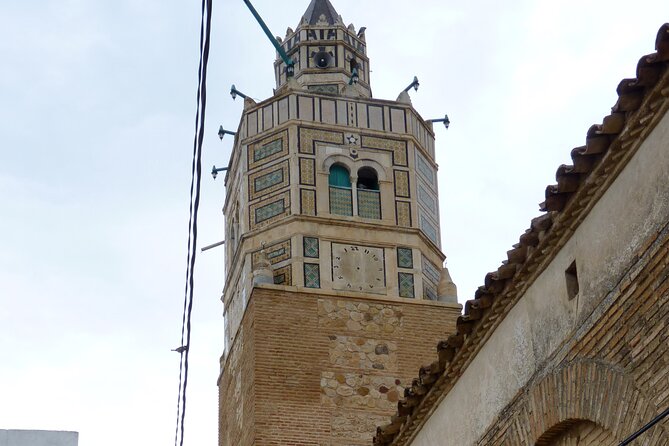
- Testour’s Grand Mosque has a rare counterclockwise clock, set into an octagonal minaret influenced by southern Spanish architecture.
- The tour is private, so only your own group participates and the day can be adjusted to some degree.
- Guides such as Chaouki, Yahya, Iskander, and Rabia have earned strong praise for clear explanations and friendly service.
- The walking is manageable but not effortless, with steep, uneven stairs at the archaeological sites.
Why this private Tunis excursion is worth your day
Tunisia is often reduced to beaches, resort hotels, and the ruins of Carthage. This excursion takes you inland, where the ancient world feels more open and less crowded. You pass through small towns and countryside before reaching two of North Africa’s finest Roman sites.
The route also gives you more than one historical layer. Testour reflects the arrival of Moorish and Andalusian communities in the early 17th century. Dougga shows how an indigenous settlement developed into an important Roman city. Bulla Regia adds Numidian, Roman, and early Christian chapters, along with architecture shaped by the climate.
At the supplied price of $127.95 per person, the value depends partly on the size of your group. You are paying for private transport, a guide, and admission to both archaeological sites. That is a fair proposition for a full day away from Tunis, especially if you value door-to-door service and a guide who can explain what you are seeing.
The experience carries a 4.9 rating from 100 ratings, with 97 percent recommended. The strongest praise centers on the guides, the quality of Dougga, the mosaics at Bulla Regia, and the low number of other people at the sites.
More Private Tours in Tunis
- Private Tour to Kairouan, El Jem & Monastir from Tunis_hammamet
★ 5.0 · 301 reviews - Private tour: Medina,Carthage ,Sidi Bou Said, Bardo Museum+lunch
★ 5.0 · 230 reviews - Carthage, Bardo Museum, Sidi Bou Said and Medina Private Day Tour
★ 4.5 · 153 reviews
Testour and the Grand Mosque’s unusual clock
Testour is the first stop, and it gives the day a human scale before the large ruins begin. The town was founded by Moorish people at the start of the 17th century, and its architecture reflects Andalusian influence.
The main sight is the Grand Mosque. Its 23-meter minaret is octagonal, with small paired windows, glazed inscriptions, and architectural details linked to Andalusia. Its form recalls the bell towers of southern Spain.
The clock is the detail you will remember. Its hands turn counterclockwise, an unusual feature that gives the minaret a distinctive identity. The mosque is not just a religious building to check off a list. It helps explain the movement of people and architectural ideas across the Mediterranean.
Set your expectations carefully. The published route calls for a panoramic look at Testour, and the amount of time spent there can vary. Some departures include a brief walk, a tea break, shopping, or a look at the mosque. Other accounts describe roughly ten minutes in town.
If Testour interests you, say so at the start. The private format makes it easier to request a little extra time, though your guide must also protect the schedule for Dougga and Bulla Regia. One practical complaint about the stop was not that Testour lacked interest, but that the visit felt too short.
Dougga, Tunisia’s great Roman hill town
Dougga deserves the largest share of your attention. The site was placed on the UNESCO World Heritage List in 1997 and is widely regarded as one of the best-preserved small Roman cities in North Africa.
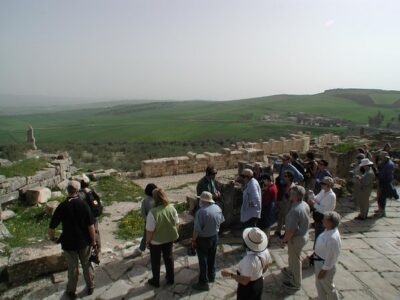
You do not simply see one famous building here. You walk through the remains of a complete town. The ancient center includes the Capitol, forum, market, and Wind Rose Square. The entertainment and public areas include a theater, circus, and thermal baths. Houses, streets, arches, and tombs help you picture how the city worked as a whole.
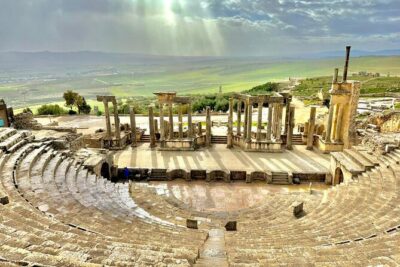
The Capitol is the visual centerpiece. From the forum area, the views across the surrounding countryside give the ruins a strong sense of place. Several people who took this excursion singled out the view from the Capitol and forum as one of the day’s best moments.
The theater is another highlight. Its surviving structure gives you a clear idea of how public performances fit into Roman civic life. The baths show the scale of public works, while the Libyco-Punic Mausoleum points to traditions that predate Roman control.
That mixture is what makes Dougga so useful for understanding Tunisia. This was not a Roman city dropped onto an empty site. It grew from an indigenous foundation and changed under Roman rule, leaving several periods visible within one boundary.
You get about three hours at Dougga, with admission included. That is a sensible amount of time for the major monuments, though you should not expect to inspect every corner at leisure. The ground is uneven, and some stairs are steep. Wear shoes with a firm grip and keep your attention on the path rather than only on the views.
Guides have made a major difference here. Chaouki is repeatedly praised for explaining Tunisian history in a way that connects the monuments to the wider country. Yahya is described as friendly and able to handle detailed questions. Iskander has been praised for giving clear explanations at both sites, while Rabia has been singled out for combining strong site knowledge with a warm manner.
Names can change according to the departure date and language requested, so you should not book solely for a particular guide unless the operator confirms that person. Still, the pattern is clear: the guiding is one of the tour’s strongest features.
Bulla Regia and the cool world below ground
Bulla Regia provides a useful contrast with Dougga. Dougga impresses through its scale and hilltop setting. Bulla Regia is more intimate, with its underground homes and striking mosaics.
The site lies near Jendouba in northwest Tunisia. Its story reaches back to a Numidian settlement founded no later than the end of the sixth century BC. It later became a royal residence, an autonomous city in the early Roman period, a municipality under the Flavian emperors, and a Roman colony under Hadrian.
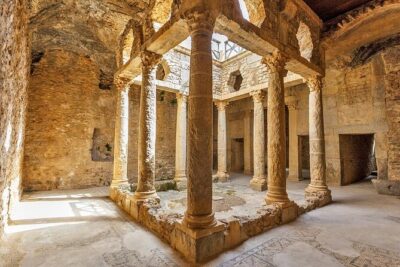
The most memorable feature is the underground domestic architecture. Roman houses here were built partly below ground, a smart response to the region’s heat. You can see how rooms, courtyards, and decorated floors created a cooler living space.
The mosaics are a major reason to visit. Several villas contain impressive surviving floors, and the mosaics can be the day’s finest detail if you enjoy Roman art. Bulla Regia is not only a collection of grand public buildings. Its homes give you a closer look at private life, decoration, and climate-conscious design.
The archaeological area also includes religious buildings: the Capitol, Temple of Apollo, two Christian basilicas, and the Church of Alexander. These remains help trace the city’s later religious changes. By the end of the fifth century, Augustine considered its inhabitants poor Christians, an indication of the religious tensions of late antiquity.
You have about two hours at Bulla Regia. That is enough to see the main areas, but the site is still partly uncovered, and some underground housing is not as visible as you might hope. The guide’s explanations matter here because the layout can be harder to grasp than Dougga’s open monuments.
A local meal in or near Bulla Regia has been part of some days, along with a tea stop in Testour or a nearby town. Do not treat lunch as a guaranteed formal feature unless it is confirmed before departure. It is best understood as a practical pause during a long rural excursion.
More Roman site days around Tunis:
- Full Day Dougga & Bulla Regia Via Testour Private tour with Lunch
★ 5.0 · 29 reviews - Private Guided Tour of Dougga and Testour Mosque
★ 4.5 · 15 reviews - Dougga and Bulla Regia Guided Tour From Tunis
★ 4.5 · 11 reviews - Private Day Tour Dougga
★ 5.0 · 6 reviews
The drive from Tunis and the shape of the day
The excursion begins at 8:00 am and lasts about eight hours. That makes it a full day, not a casual half-day outing. The sites are inland and far enough apart that road time is part of the experience.
The drive takes you through northern Tunisia, with small towns and countryside along the way. One particularly enjoyable aspect is seeing ordinary local life beyond the capital. Depending on timing, you might pass through a weekly market or stop for local fruit such as mandarins.
The private vehicle is a real advantage for this route. You do not wait for a large group at each stop, and your guide can answer questions specific to your interests. Families and couples also get more control over breaks, photography, and walking speed.
The main practical concern is driving quality. Most accounts describe pleasant drivers, but one serious complaint raised concerns about high speeds and distracted driving. The operator responded that passenger safety is a priority and that vehicles are electronically limited. Even so, if your driver makes you uncomfortable, speak up early and clearly.
The schedule can also feel tight. Testour is the easiest stop to shorten, while Dougga and Bulla Regia need enough time to justify the long drive. If you want an extended town visit, ask about it before leaving Tunis rather than assuming the published route guarantees a fixed amount of time.
Walking, weather, and what to bring
Most people can take part, and the excursion allows service animals. The sites are outdoors and spread over uneven archaeological ground, so you should be comfortable walking for several hours.
At Dougga, expect slopes, worn stone, and steep steps. Bulla Regia also requires walking between exposed ruins and lower-level areas. The route is not described as extreme hiking, but it is more demanding than a paved museum visit.
Bring sturdy walking shoes, water, sun protection, and a hat. Weather matters enough that the experience requires good conditions. If poor weather forces cancellation, you are offered another date or a full refund.
A phone or camera is useful, especially at Dougga, where the views and surviving structures work well in wide shots. At Bulla Regia, look down as often as you look around. The mosaics and below-ground rooms are easy to miss if you focus only on the larger walls.
Guide quality and the private-tour difference
The guide is central to the value of this excursion. At Dougga and Bulla Regia, a good explanation turns scattered stones into a readable city. You want someone who can explain the connection between Numidian beginnings, Roman administration, domestic life, and later Christianity.
Chaouki receives especially strong praise for historical detail, friendly conversation, and thoughtful timing at the sites. He has also been praised for taking photographs during the day. Yahya, Iskander, Rabia, and Yosra are also named positively for their clear English, patience, and ability to answer questions.
There is one point to clarify before you book. One account says the main guide did not meet the group until Dougga, with the early Testour stop handled by the driver. That may not apply to every departure, but it means you should ask who will guide Testour and how long the town visit will last.
The private setup is best for people who prefer flexibility to a fixed group schedule. It is also useful if you want to ask detailed questions about Roman architecture or take your time with mosaics. Group discounts can improve the per-person value if you are traveling with family or friends.
Price, cancellation, and who gets the best value
At $127.95 per person, the excursion is not the cheapest way to reach Dougga and Bulla Regia. A private car for a full day costs more than joining a large bus, and the route covers substantial ground.
The price makes more sense if you value three things: private transport, a dedicated guide, and included admission to both archaeological sites. You also avoid arranging separate transport between remote locations, which can be difficult if you do not speak Arabic or French.
I would book it for a first visit to Tunisia if you have at least three days in the country and want ancient sites beyond Carthage. I would hesitate if your main interest is Andalusian architecture, since Testour may receive only a short stop. I would also compare alternatives if you want a relaxed day with long meals and plenty of unplanned time.
Free cancellation is available up to 24 hours before the 8:00 am start for a full refund. Changes or cancellations inside that window are not accepted, and poor weather can lead to a new date or full refund.
Should you book this Dougga and Bulla Regia day trip?
Book it if Dougga is high on your list and you want to pair it with Bulla Regia without handling rural transport yourself. The combination is excellent: Dougga gives you grand civic ruins and sweeping views, while Bulla Regia gives you houses, mosaics, and a cooler underground world.
Ask before departure how much time is planned for Testour, who will guide that stop, and which language your guide will use. Also confirm the pickup details and keep an eye on the day’s pace.
For archaeology fans, this is one of the strongest day trips from Tunis. The sites are substantial, the crowds can be light, and the private format gives the outing a personal feel. Just bring good shoes, accept that Testour may be brief, and choose this tour for the two ancient cities rather than for a long village visit.
FAQ
What time does the excursion start?
The tour starts at 8:00 am.
How long does the tour last?
The excursion lasts approximately eight hours.
Is the tour private?
Yes. Only your own group participates in the private activity.
Is pickup available?
Yes. Pickup is offered.
Are admission fees included?
Admission is included for Dougga and Bulla Regia.
How much time is planned for Dougga?
The itinerary provides about three hours at Dougga.
How much time is planned for Bulla Regia?
The itinerary provides about two hours at Bulla Regia.
Can I cancel for a full refund?
Yes. You can cancel at least 24 hours before the experience start time for a full refund. Cancellations made less than 24 hours before the start are not refunded.
Just added around Tunis
- Private Group Day Tour Tunis Medina Carthage Sidi Bou Said★ 4.5 · 3 reviews
- Private Tour Bardo Museum, Carthage, Sidi Bou Said and Medina★ 4.5 · 3 reviews
- Explore Tunisia in Depth:The Private Grand Tour in 8 Days★ 5.0 · 3 reviews
- 3-Day South of Tunisia Guided Tour from Tunis★ 4.0 · 3 reviews
- Bardo Museum , Oudhna and the roman aqueduct★ 5.0 · 4 reviews
- From Tunis: Star Wars 5 day tour★ 5.0 · 4 reviews
- DAY TRIP TO Dougga & Bulla Regia , DEPARTURE FROM Tunis★ 5.0 · 4 reviews
- Private Walking Tour of Carthage Archaeological Site in Tunisia★ 4.5 · 4 reviews
Dougga & Bulla Regia Roman Sites, compared.
Full Day Dougga & Bulla Regia Via Testour Private tour with Lunch
Read our review →
Private Day Trip to Testour, Dougga and Bulla Regia from Hammamet
Read our review →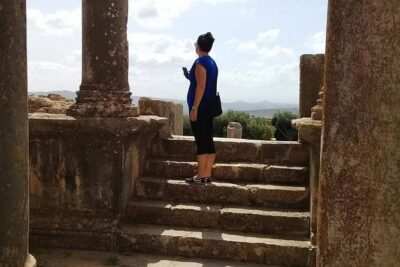
Private Guided Tour of Dougga and Testour Mosque
Read our review →
Bulla Regia and Beni Mtir Cascade Daytrip from Tunis
Read our review →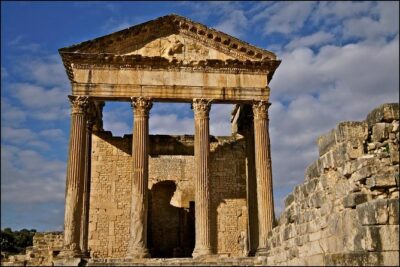
DAY TRIP TO Dougga & Bulla Regia , DEPARTURE FROM Tunis
Read our review →Browse the lists this tour appears in