
Reviewed · TUNIS
7 Day Guided Tunisia Tour Including Pickup
The most striking part of this seven-day Tunisia tour is its range. In one trip, you move from the Roman amphitheater at El Jem to underground homes in Matmata, fortified Berber granaries, Sahara dunes, ancient temples, Islamic medinas, and the blue-and-white streets of Sidi Bou Said. It is a big country-spanning route, not a relaxed seaside holiday.
I like the strong mix of Roman and Islamic history, and I like that the route reaches southern Tunisia, where the desert sites feel very different from Tunis and the coast. Guides including Salem, Ziad, Yassine, and Daoud are praised for careful planning, warmth, language skills, and an ability to explain the past without making it dry. The main consideration is pace: long drives and many stops leave little room for wandering slowly.
Key points at a glance
- A full sweep of Tunisia: The route covers Sousse, El Jem, Matmata, the Tataouine area, Douz, Tozeur, Kairouan, Dougga, Tunis, Carthage, and Sidi Bou Said.
- A private tour for your group: You do not share the activity with unrelated participants, which allows some flexibility in timing and stops.
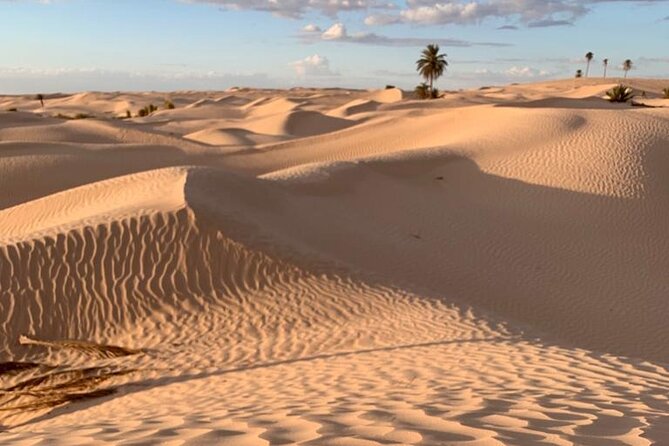
- Desert scenery with real variety: Expect salt flats at Chott el Jerid, mountain springs at Chebika, abandoned Tamerza, and the dunes around Ong Jemel.
- Strong guide support: Salem receives especially high praise for his care, flexibility, and command of history. Ziad, Yassine, and Daoud are also named for their strong guiding.
- Meals are partly covered: Six breakfasts and six dinners are included, while entrance fees and all fees and taxes are not included.
- A serious amount of road time: One account describes roughly 2,100 kilometers of driving, useful context for anyone who dislikes long transfers.
Why this route works for curious first-time visitors
Tunisia is compact enough to visit in a week, yet varied enough to feel like several different countries. This itinerary links the Mediterranean coast, the central plains, the dry south, the Sahara edge, mountain oases, and the capital region.
I especially like the way the route connects places rather than treating each sight as an isolated photo stop. El Jem gives you Roman spectacle. Matmata and Chenini show how people adapted to difficult dry conditions. Kairouan and the medinas bring Islamic architecture and traditional commerce into the picture. Dougga and Carthage add two more major chapters from antiquity.
The tour also benefits from local planning. The supplied information describes tailor-made routes, and the strongest comments repeatedly point to guides adjusting plans around the group. Salem is singled out for handling details, staying attentive, and helping the trip run smoothly. One account describes him as so well-informed that the group nicknamed him Google, while another praises his Spanish and Portuguese.
That personal guidance matters in Tunisia. Many ruins are spread over wide areas, and the meaning of a temple, granary, or old village is not always obvious from the stones alone. A good guide helps you see how religion, trade, farming, defense, and climate shaped each place.
The weakness is the same thing that makes the tour ambitious. You cover a lot of ground. A two-hour stop can feel generous at a small site, but it can also feel short at a major archaeological area such as Carthage or Dougga. If you want long café breaks, independent shopping, or unhurried photography, ask about the daily driving schedule before booking.
More Guided Tours in Tunis
- Guided Bike Tour of Carthage Archeological Site in Tunisia
★ 5.0 · 88 reviews - Guided tour in the UNESCO world heritage Medina of Tunis
★ 5.0 · 68 reviews - Group Guided Bike Tour of Carthage Archeological Site in Tunisia
★ 5.0 · 57 reviews
Day 1: Sousse, El Jem, and underground Matmata
The first day begins at the Medina of Sousse, a UNESCO World Heritage site and one of the clearest introductions to Tunisia’s Islamic urban tradition. The old quarter is a network of narrow lanes, courtyards, shops, cafés, and traditional houses, with the Great Mosque among its key landmarks.
The planned visit is about 30 minutes, so treat Sousse as a quick orientation rather than a full exploration. I would use this time to notice the shape of the old city and ask your guide how the medina fits into the wider history of coastal Tunisia.
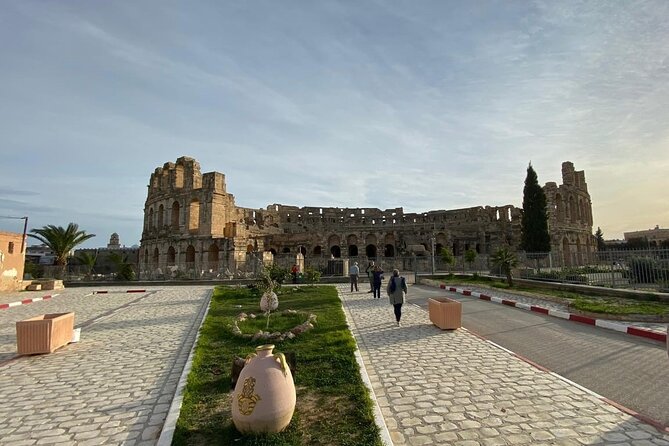
The route then heads to El Jem, where the Roman amphitheater is the day’s major historical sight. Built around the third century during the reign of Emperor Gordian, it could hold as many as 35,000 spectators. Its scale is startling, especially because it rises from a modern Tunisian town rather than an ancient imperial capital.
Two hours is a useful amount of time here. You can walk through the seating areas, inspect the lower passages, and understand how public spectacles worked in the Roman Empire. This is one of the places where a guide can add real value, explaining what you are seeing instead of leaving you with a grand shell and a camera.
Matmata changes the mood completely. The village sits in a dry, rocky region known for troglodyte homes, dwellings carved into soft limestone around a central courtyard. The rooms sit below ground, which helped protect residents from severe desert heat and cold.
The visit lasts about two hours. Some traditional homes have been turned into unusual hotels, giving you a chance to see how practical domestic design responded to the climate. The stop is more than a curiosity. It shows that southern Tunisian architecture developed from daily needs, not decoration alone.
Because this is a long first day, comfortable clothing, water, and sensible shoes will help. The route combines three very different places, but it also begins the tour at full speed.
Day 2: Berber villages and the ksars of Tataouine
Day two focuses on the dry south and the area around Tataouine. At Chenini, you explore a hill village shaped by Berber building traditions. Stone and mud-brick homes line narrow lanes, while fortified granaries and settlements cling to the rocky slopes.
The two-hour stop gives you time to look beyond the famous views. Chenini’s ksour were used to protect crops and stored goods from raids and the harsh desert climate. Flat-roofed homes, tight passageways, and compact construction all reflect the need for shelter and security.
Chenini can be physically more demanding than a museum visit. The village is built into uneven ground, so take your time on slopes and rough paths. The reward is a place that still feels tied to its setting rather than arranged for sightseeing.
At Ksar Ouled Soltane, you see one of southern Tunisia’s best-known fortified granaries. A ksar could function as a fortified village or a storage complex, with individual chambers used by Berber communities to protect grain and other possessions.
The visit is scheduled for one hour, and an entrance ticket is listed as included for this stop. Look closely at the repeating storage rooms and the way the complex rises in layers. The architecture is practical, but its repeated forms create a powerful visual effect.
Ksar Hadada brings another angle. The site sits in rocky desert country and is connected with the film locations and inspiration associated with Star Wars. The two-hour stop gives you time to enjoy the setting as well as the cinema connection.
I like this day because it avoids reducing southern Tunisia to sand and camels. You see how communities stored food, built homes, and defended themselves before modern roads and large towns changed the region. The film connection may attract some people, but the older Berber structures are the stronger reason to come.
Day 3: Douz and the salt flats of Chott el Jerid
At Douz, you reach the town often called the gateway to the Sahara. It is a starting point for desert trips and camel excursions, and the planned two-hour visit gives you a sense of the town’s role at the edge of the desert.
The information provided does not specify a camel ride, so do not assume one is included. Douz is best understood here as a transition point, where the built world gives way to wide, dry country.
Next comes Chott el Jerid, a shallow salt lake with broad salt flats and mud plains. In the dry season, evaporation leaves behind pale crusts and geometric patterns. After rain, parts of the lake can fill and attract flamingos and other migratory birds.
The stop is about one hour. Conditions and colors can change with weather and season, so the exact view will not be identical on every departure. The site is less about monuments and more about scale, glare, silence, and the strange texture of a place that is sometimes lake and sometimes salt plain.
This is another day when road time matters. The route is designed to connect distant regions, not to keep you in one town. If you enjoy watching Tunisia change outside the vehicle, the driving becomes part of the experience. If you prefer a slower schedule, this is a point to discuss before paying.
A few more Tunis half-days to weigh up
- Tunisia 7-Day tour
★ 5.0 · 6 reviews
Day 4: Mountain oases, old Tamerza, and film country
The mountain oasis of Chebika is one of the route’s most appealing changes of scenery. Ain Chebika, a natural spring, sends water down the mountainside through cascades and pools surrounded by palms and rocky cliffs.
The planned visit lasts two hours, with an entrance ticket listed as included. The contrast is the point: dry mountains give way to water and palms in a very small area. Walk carefully near wet surfaces, and allow time to enjoy the setting rather than treating the spring as a quick stop.
At Tamerza, you visit the abandoned old village. Heavy rainfall caused flooding in the 1960s, and the former community was left behind. Its crumbling homes and narrow streets now offer a quiet look at a settlement interrupted by nature.
One hour is planned here. The ruins are not polished or reconstructed, which gives them an unusual mood. You can see how homes once fitted together, but you should also remember that this is a fragile old site, not a modern attraction built for easy access.
The day ends around Ong Jemel and the Eriguet Dunes, known for desert scenery and their connection with Star Wars filming locations. The two-hour stop includes admission according to the itinerary.
This is a strong photography day, but the desert light can be harsh. Bring sun protection and water, and expect open ground with little shade. I like the balance between Chebika’s flowing water, Tamerza’s abandoned streets, and the dry dunes at Ong Jemel. It gives the desert region more depth than a single sand excursion would.
Day 5: Sbeitla and the holy city of Kairouan
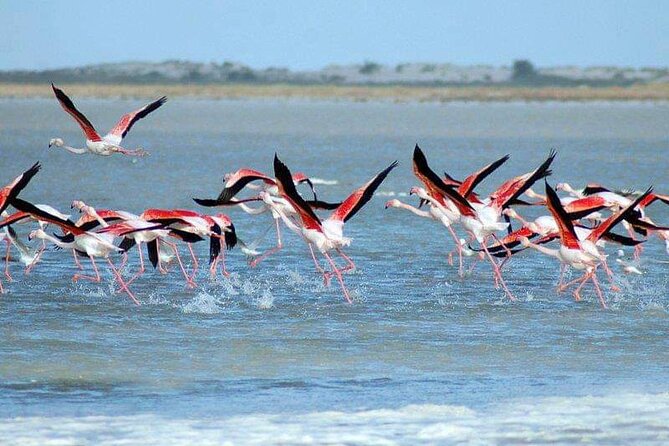
Sbeitla is a major Roman archaeological site with temples, a forum, basilicas, theaters, baths, houses, and mosaics. The three temples dedicated to Jupiter, Juno, and Minerva are the visual centerpiece, but the wider site helps you understand how a Roman city functioned.
The planned visit is two hours, and an entrance ticket is listed as included. Sbeitla is spread out, so wear shoes that can handle uneven ground. A guide is particularly useful here because the remains make more sense when you can connect temples, public spaces, private homes, and civic life.
After the Roman world comes Kairouan, founded in 670 AD and an early center of Islamic learning and government in North Africa. The city became the capital of Ifriqiya, a region that included much of present-day Tunisia along with parts of Algeria and Libya.
The two-hour stop provides a helpful counterpoint to Sbeitla. Instead of Roman temples and forums, you encounter a city shaped by Islamic scholarship, worship, and trade. The itinerary does not specify the exact sights visited in Kairouan, so ask your guide how much time will be spent in the old city and which landmarks are planned.
I consider this one of the best intellectual pairings on the tour. Sbeitla shows Roman power in North Africa. Kairouan shows the later growth of Islamic civilization in the same broad region. The shift is quick, but it gives the trip a clear historical arc.
Day 6: Dougga and the old quarters of Tunis
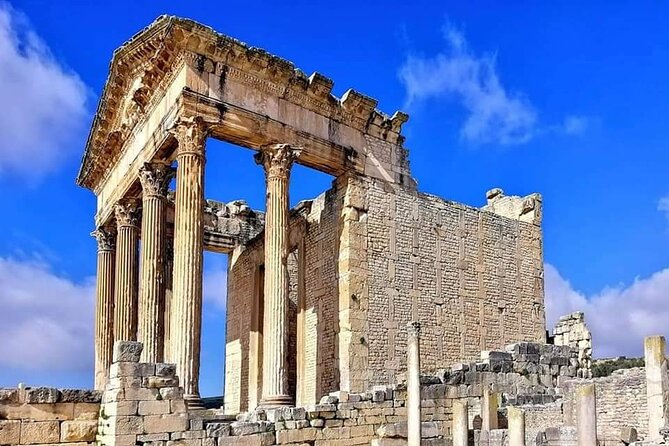
At Dougga, you walk through one of Tunisia’s most important ancient sites, a UNESCO World Heritage location with temples, a theater, public buildings, mosaics, and streets that remain unusually readable.
The two-hour visit is enough to see the main areas, though not enough to inspect every ruin at a leisurely pace. Dougga rewards a slower eye. Notice how the city occupies its setting, how the public buildings relate to one another, and how the surviving stonework gives shape to everyday Roman life.
An entrance ticket is listed as included here. Still, the general terms say monument entrance fees are not included, creating a pricing detail you should clarify before departure. The same issue appears elsewhere in the itinerary, where some individual stops show admission included while the general terms exclude entrance fees.
Later, the Medina of Tunis offers a change from open archaeological sites to a dense old city. Founded in the ninth century, it contains souks, workshops, traditional architecture, and lanes that can feel confusing in the best way.
Only one hour is scheduled, so think of this as a first taste rather than a complete visit. Ask your guide to point out the crafts, doors, courtyards, and historic buildings that best show the character of the medina. You may want extra independent time here on another day if shopping or architecture is a priority.
Day 7: Sidi Bou Said and the remains of Carthage
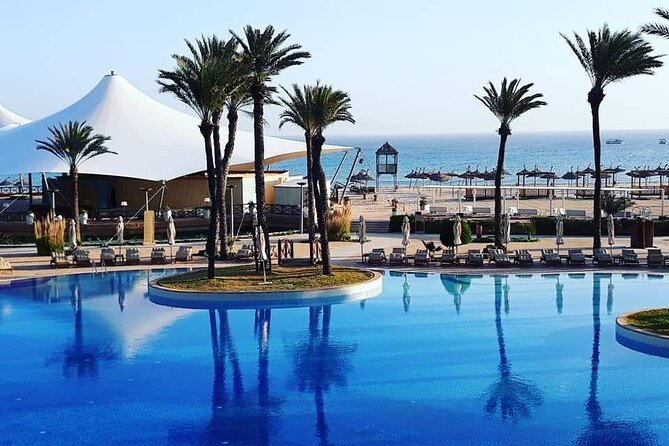
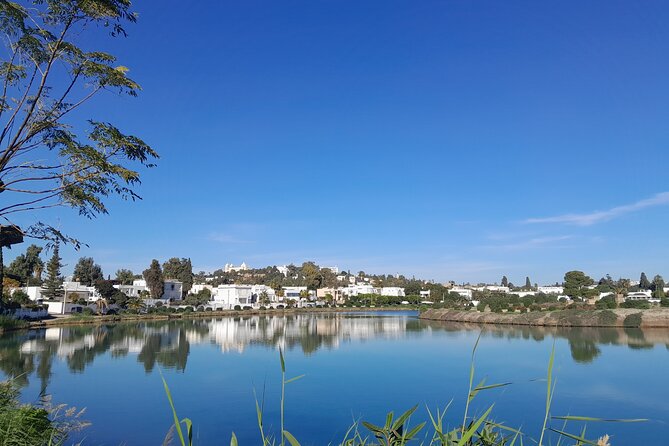
The final day begins in Sidi Bou Said, the hilltop village overlooking the Mediterranean. White buildings, blue doors, blue window frames, and wrought-iron details give the town its familiar look.
Two hours allows you to stroll the lanes and enjoy the views without rushing. This is one of the easiest places on the route for a relaxed break, although the popularity of its appearance means you should not expect a completely quiet village.
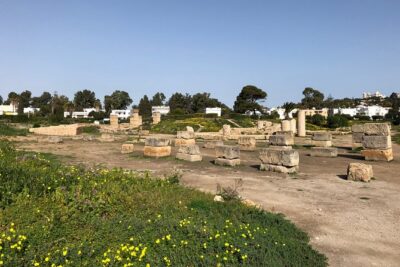
The final major stop is Carthage, whose ruins are spread across a wide area along the coast. The itinerary highlights the Tophet, an ancient burial ground with stone markers, and the Antonine Baths, a huge complex that once served as a social and bathing center.
Two hours is a useful introduction, but Carthage is too extensive to absorb in one short visit. Your guide can help you choose the most important remains and explain how the Punic and Roman periods fit together. An entrance ticket is listed as free in the itinerary, while the overall terms say monument fees are excluded, so confirm the actual payment arrangements.
Ending at Carthage works well. You finish with one of North Africa’s great ancient cities, then return to the modern capital region rather than ending in the desert.
Price, meals, transport, and pace
At $1,858.33 per person, this is not a budget sightseeing shuttle. Its value depends on what you want from a week in Tunisia. You are paying for private touring, pickup, a driver and guide team, route planning, and a substantial amount of ground coverage. Six breakfasts and six dinners are included.
The price becomes easier to justify if you value convenience and local coordination. The route crosses roughly 2,100 kilometers according to one account, and arranging those transfers, hotels, meals, and site visits independently would take time. Several accounts also describe comfortable vehicles, good organization, varied hotels, and representative food.
Still, the price does not cover all fees and taxes, and entrance costs need clarification. Ask for a written breakdown of monument admissions, hotel details, lunches, and any desert activities before booking. Group discounts are available, which may improve the value for larger parties.
Pickup is offered, with the stated starting point at Carthage Airport in Tunis. The published operating window runs daily from 8:00 AM to 6:00 PM, from December 4, 2024 through December 28, 2025. Confirmation is provided at booking, and free cancellation is available up to 24 hours before the start time.
The activity is private for your group, and most people can participate. It is near public transportation, though the tour itself relies on arranged vehicle travel across the country.
Who should book this Tunisia tour?
I would choose this trip if you want a broad first look at Tunisia and care more about variety than free time. It suits history fans, photographers, couples, families with an appetite for long drives, and anyone who prefers a guide to handle the route.
It is also a good fit if you want contact with several sides of the country: coastal cities, Islamic medinas, Roman ruins, Berber architecture, mountain springs, salt flats, and desert film locations.
I would hesitate if you need a slow holiday, dislike changing hotels, or want several full days in one place. The schedule is ambitious, and some two-hour visits cover sites that deserve longer.
Final call: book it for breadth, not leisure
Book this tour if your goal is to see the greatest possible range of Tunisia in seven days with a private team and local guidance. The strongest feature is the combination of places, from El Jem and Dougga to Matmata, Chebika, Kairouan, and Carthage.
Before committing, confirm the hotel standard, exact pickup details, entrance fees, and how much flexibility you have each day. If Salem is available, his record of careful planning, language ability, and personal attention makes him a strong choice, though the operator may assign another guide such as Ziad, Yassine, or Daoud.
You will work hard for this itinerary, but you will also see a side of Tunisia that a short coastal break cannot reach.
FAQ
How long is the tour?
The tour lasts approximately seven days, with activities scheduled across seven itinerary days.
Where does the tour start?
The stated meeting point is Carthage Airport in Tunis, Tunisia. Pickup is offered.
Is this a private tour?
Yes. Only your group participates in the activity.
What meals are included?
Six breakfasts and six dinners are included. The supplied details do not state that lunches are included.
Are entrance fees included?
The general terms say monument entrance fees are not included. However, some individual stops, including Ksar Ouled Soltane, Chebika, Ong Jemal, Sbeitla, and Dougga, are marked as including admission. Confirm the exact fee arrangement before booking.
Can most people participate?
Yes. The activity information says most people can participate, and it is near public transportation.
What is the cancellation policy?
You can cancel at least 24 hours before the experience start time for a full refund. Cancellations or changes made less than 24 hours before the start time are not accepted for a refund.
Just added around Tunis
- Private Group Day Tour Tunis Medina Carthage Sidi Bou Said★ 4.5 · 3 reviews
- Private Tour Bardo Museum, Carthage, Sidi Bou Said and Medina★ 4.5 · 3 reviews
- Explore Tunisia in Depth:The Private Grand Tour in 8 Days★ 5.0 · 3 reviews
- 3-Day South of Tunisia Guided Tour from Tunis★ 4.0 · 3 reviews
- Bardo Museum , Oudhna and the roman aqueduct★ 5.0 · 4 reviews
- From Tunis: Star Wars 5 day tour★ 5.0 · 4 reviews
- DAY TRIP TO Dougga & Bulla Regia , DEPARTURE FROM Tunis★ 5.0 · 4 reviews
- Private Tour to El Jem, Sousse, and Monastir From Tunis_Hammamet★ 5.0 · 4 reviews
Tunis Tours, compared.
Private Tour to Kairouan, El Jem & Monastir from Tunis Hammamet
Read our review →
Private tour: Medina,Carthage ,Sidi Bou Said, Bardo Museum+lunch
Read our review →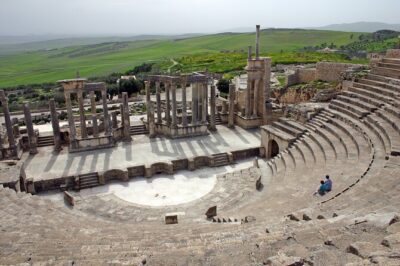
Private Excursion to Testour, Dougga and Bulla Regia from Tunis.
Read our review →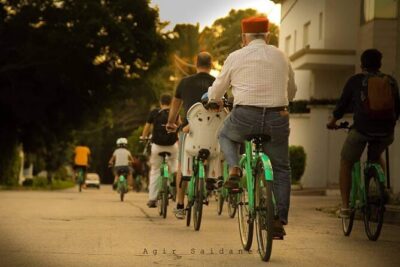
Guided Bike Tour of Carthage Archeological Site in Tunisia
Read our review →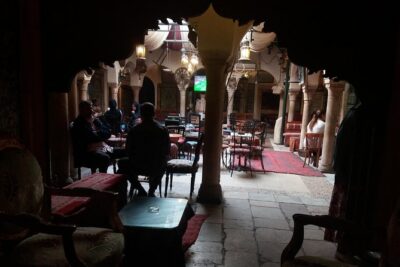
Guided tour in the UNESCO world heritage Medina of Tunis
Read our review →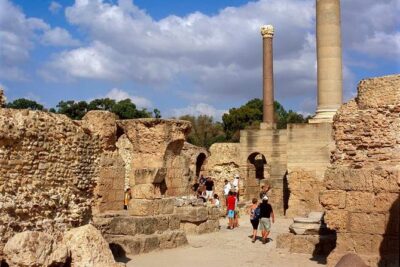
Archaelogical Site Of Carthage + Picturesque Village Of Sidi Bou Said
Read our review →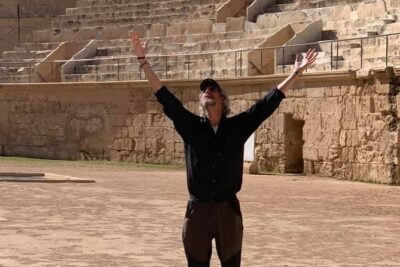
Browse the lists this tour appears in