
Reviewed · EL JEM
Colosseum of El Jem and Fatimid Medina Mahdia Tour
El Jem’s vast Roman amphitheater is the star here, but the day begins with something quite different: Mahdia, a narrow seaside city shaped by Fatimid rulers, Ottoman soldiers, fishermen, and silk workers. You move from a medieval gate and old mosque to a Roman arena in one long, full day.
I like the private vehicle, since your group does not share the ride with strangers, and I like the mix of major monuments with Mahdia’s beaches and old streets. The main caution is practical: eight hours is a lot of ground to cover, and one recorded visit found two sites closed and the guide poorly informed about access. Confirm opening conditions before departure.
Key points at a glance
- Two very different historic cities: Mahdia brings Fatimid and Ottoman architecture, while El Jem delivers one of North Africa’s grandest Roman monuments.
- A private eight-hour outing: Only your group participates, with an air-conditioned vehicle, private transport, and WiFi on board.
- Mahdia’s Skifa Kahla: Walk through a tenth-century gate that formed part of the old city’s defensive system.
- A strong museum stop: Mahdia’s museum covers Libyco-Punic, Roman-African, Byzantine, and Islamic material, including finds from a famous Roman shipwreck.
- El Jem admission included: You can explore the amphitheater with the tour rather than arranging separate transport and tickets.
- Lunch costs extra: Seafood is part of Mahdia’s local identity, but the meal is not included in the $152.69 price.
Why this day trip works
This tour is built around contrast. In Mahdia, you see a compact old town on a thin peninsula, with the sea close at hand and several monuments within a manageable walking circuit. Later, El Jem shifts the scale completely. Its Roman amphitheater is enormous, open, and highly preserved, with the sort of stonework that makes ancient public entertainment feel startlingly real.
I like that the day is not limited to one famous monument. You get a little of Mahdia’s defensive architecture, religious buildings, museum collections, coastal scenery, and old-town character before reaching El Jem. That gives you a fuller sense of Tunisia than a quick arena visit alone.
The tradeoff is pace. The listed stops add up to just over four hours, before driving, meals, photo pauses, and transitions. That leaves a fairly tight schedule for an eight-hour day. You should expect a highlights tour, not a slow archaeological study.
The private format helps. You are not tied to the interests or energy level of a large group, and the air-conditioned vehicle matters in Tunisia’s heat. WiFi is also included on board, though the experience is mainly about getting out and walking among the monuments rather than spending time connected.
More El Jem amphitheatre trips:
- Private Tour to Kairouan, El Jem & Monastir from Tunis_hammamet
★ 5.0 · 301 reviews - Daytrip to Kairouan and El Jem Colosseum
★ 4.5 · 55 reviews - Kairouan and El Jem Private Day Tour
★ 4.5 · 38 reviews
Starting at Mahdia’s Skifa Kahla
Your first stop is Skifa Kahla, the great fortified gate leading into Mahdia’s historic center. The original gate dates to the tenth century, although the defensive system was rebuilt by the Turks near the end of the sixteenth century.
The gate once formed part of the second line of defense. Its job was simple: block access to the city. Today, it gives you an immediate sense of Mahdia as a fortified settlement rather than just a seaside town.
Allow about 25 minutes. Admission is free, so this is a quick orientation stop rather than a long museum visit. Look closely at the passage and surrounding walls. The value here is in understanding the city’s layout before you walk farther into the old quarter.
Mahdia Museum and the story beneath the sea
The Mahdia Museum occupies a renovated former town hall near the entrance to the old town. It covers both the city’s own past and broader chapters of Tunisia’s history.
On the ground floor, you can see objects linked to Libyco-Punic and Roman-African antiquity. Upstairs, the displays turn toward Byzantine and Islamic periods. Two marble columns represent Greek civilization, although their surfaces were partly damaged by mollusks after spending time underwater.
Those columns came from a Roman wreck off Mahdia. Much of the cargo was recovered in the 1940s, giving the museum an unusual connection to underwater archaeology. That detail makes this more than a standard collection of old stones. The sea beside Mahdia is part of the story.
The visit lasts about 40 minutes, and admission is included. I would give this stop your full attention, especially if you want context for the monuments that follow. The museum is not presented as a giant national collection, so you should expect a focused visit rather than hours of galleries.
Walking through Mahdia’s old town
Mahdia grew as the first capital of the Fatimid caliphs in the tenth century. The city sits on a narrow peninsula, built close to the rock and surrounded by water on three sides. That setting helps explain its appeal: the old town, fishing culture, beaches, and monuments are all tied closely to the coast.
The tour gives you about an hour here. This is your chance to slow down after the museum and notice the everyday side of Mahdia. The city is associated with fishermen and silk weavers, and the old town retains the feel of a traditional small city rather than a purpose-built resort district.
The itinerary also mentions photo stops at white sand beaches and clear turquoise water. Treat these as scenic pauses, not a guaranteed long beach visit. The schedule is already full, and the exact length of each photo stop is not specified.
If you want the most authentic sense of Mahdia, this may be the most useful part of the day. The famous buildings are important, but the peninsula itself explains why the city developed as it did. You see the relationship between the defensive walls, the sea, the port, and the old residential streets.
A few more Tunis half-days to weigh up
- Private tour: Medina,Carthage ,Sidi Bou Said, Bardo Museum+lunch
★ 5.0 · 230 reviews - Carthage, Bardo Museum, Sidi Bou Said and Medina Private Day Tour
★ 4.5 · 153 reviews - Private Excursion to Testour, Dougga and Bulla Regia from Tunis.
★ 5.0 · 100 reviews - Guided Bike Tour of Carthage Archeological Site in Tunisia
★ 5.0 · 88 reviews
Inside Ottoman Borj El Kebir
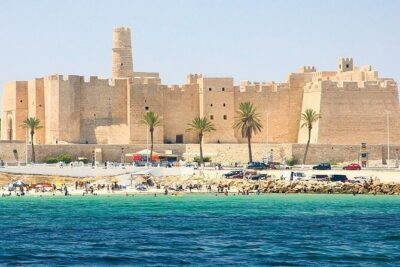
Next comes Borj El Kebir, also called the Kasbah. The fortress was built at the end of the sixteenth century on the site of an older Fatimid palace. It is considered a strong example of Ottoman military architecture in Tunisia.
The building follows a quadrangular plan and was later strengthened with corner bastions. Its outer wall originally had one entrance. A second access point was added in the nineteenth century after the building was put to prison use.
Inside, a vaulted and bent passage leads into a courtyard. Rooms open onto that courtyard, and a small oratory from an earlier building was preserved and folded into the fortress. These details reward a careful look. This is not just a fortress wall and a view. Its changes of use are visible in the way the structure was built and adapted.
The planned visit is 30 minutes, with admission included. That is enough for a brisk look at the entrance, courtyard, rooms, and military form. If you enjoy architecture, you may wish the schedule allowed more time. The fortress is one of the places where a guide can add real value by explaining the Fatimid, Ottoman, and prison chapters in sequence.
The Great Fatimid Mosque
The Great Fatimid Mosque was built by Obeid Allah el Mehdi between 909 and 934. It is identified as the first Fatimid mosque, and its design differs from many mosques you may know because it has no minaret. The call to prayer came from one of two towers.
The mosque was changed during the period of Spanish occupation and later underwent major restoration work beginning in 1964 under President Bourguiba. Only the northern part dates from the tenth century, while the rest was redesigned according to the original plan. Part of the site was reclaimed from the sea.
That last point is especially useful when you look at the building’s position. The mosque is not simply an isolated religious monument. It belongs to the planned Fatimid city, where the coast, defenses, palace area, and place of worship worked together.
The stop lasts about 25 minutes. Admission is included. You will not have time for an extended architectural study, but you can take in the broad plan and listen for an explanation of what is original, reconstructed, or changed.
The El Jem amphitheater is the grand finale
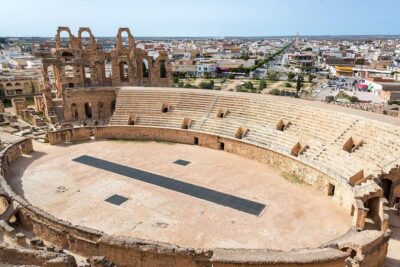
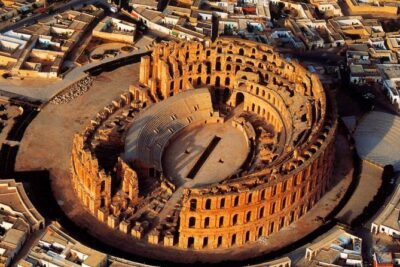
After Mahdia, the tour reaches the El Jem Amphitheatre, a UNESCO World Heritage Site and the largest single attraction on this route. The arena recalls Rome’s Colosseum, but the Tunisian setting gives it a different character. Its huge stone walls rise from a town rather than from the center of Rome, and the scale is still startling.
The listed visit lasts one hour, with admission included. That is a reasonable amount of time to see the main arena, study the outer walls, and picture the crowds and gladiatorial spectacles once held here. The structure’s preservation lets you read the building as architecture, not just as a ruin.
You can expect imposing arches, broad stone seating areas, and the arena space itself. The most useful part of a guided visit is not simply hearing that Roman games took place here. It is understanding how the building handled people, performers, and animals, if those subjects are covered by your guide.
This is where guide quality matters most. One recorded complaint said the guide knew little about the area and incorrectly claimed another site could not be reached. That is a serious concern for a history-focused day. Since no guide’s name is provided, I would contact Tunisia Guided Tours before booking and ask who will lead the visit and whether the amphitheater will receive a proper historical explanation.
The amphitheater is impressive even without a perfect commentary, but good interpretation changes the experience from a photo stop into a meaningful visit.
The mosaic museum at ancient Thysdrus
The tour description also includes a visit to the archaeological mosaic museum of Tythdrus, the ancient name associated with El Jem. However, the timed itinerary lists the amphitheater as the final stop and does not give a separate duration or admission detail for the museum.
That mismatch is worth clearing up before you pay. Ask whether the mosaic museum is included on your departure date, whether it replaces another stop, and how much time is allocated to it. This matters because Tunisia’s Roman mosaics are a major part of the El Jem area, and you should not assume a museum visit is guaranteed simply because it appears in the general description.
The same caution applies to Mahdia’s sites. One recorded experience found two locations closed and said the guide gave incorrect information about another site being inaccessible. Closures can happen, but the operator should be able to tell you what the backup plan is.
Is $152.69 good value?
At $152.69 per person, this is not a budget outing. The value depends heavily on how many people are in your private group and how well the day is guided.
The price includes private transportation, an air-conditioned vehicle, onboard WiFi, entrance fees, and taxes. Those inclusions remove several common costs and make the price easier to judge. You are paying for a full day of transport between Tunis, Mahdia, and El Jem, along with a broad set of admissions.
The private arrangement is the biggest value point. If several people share the booking, the cost can make more sense than arranging individual transport and entrance tickets. You also gain flexibility within the group, although the fixed schedule still limits how long you can linger.
Lunch is not included. Budget separately for a midday meal, especially if you want Mediterranean seafood in Mahdia. The description points toward local seafood, but it does not name a restaurant or state that a particular meal stop is guaranteed. Ask what lunch arrangements are planned before departure.
The experience is often booked well ahead, with an average lead time of 97 days. That suggests you should not leave it until the last moment if this is central to your Tunisia plans. Still, confirm the operating details close to the date, since the only detailed complaint concerned closures and inaccurate access information.
Who should book this Mahdia and El Jem day?
I would choose this tour if you want to combine coastal Tunisia with a major Roman site in one day and prefer a private vehicle over public transport. It suits first-time visitors who want a broad introduction without arranging several separate excursions.
It is also a good fit if you enjoy architecture more than shopping or long beach hours. The route gives you defensive walls, a fortress, a historic mosque, a museum, an old town, beaches, and a Roman amphitheater.
You may want another option if your top priority is slow, expert-led archaeology. The schedule is packed, the guide is not named, and the one detailed complaint raises questions about site knowledge and current access. A specialist guide or a tour centered only on El Jem could offer more depth.
The route may also feel rushed if you want a relaxed seaside day. Mahdia’s beaches are included as scenic highlights, but the main focus is cultural sightseeing, not extended swimming or lounging.
Booking confirmation arrives at the time of booking. Pickup is offered, the activity is private, service animals are allowed, and most people can participate. Free cancellation is available until 24 hours before the start time. After that point, the payment is not refunded, and changes are not accepted.
Should you book it?
Book this experience if you value convenience and range. The combination of Mahdia’s Fatimid and Ottoman monuments with El Jem’s Roman amphitheater gives you an unusually varied day, and the included transport and admissions simplify the planning.
Before committing, contact the operator with three questions: Which sites will be open on your date? Is the Tythdrus mosaic museum definitely included? Who is the guide, and what language will the tour use? If you receive clear answers, the tour can be a worthwhile private introduction to two of Tunisia’s strongest historic destinations.
If the answers are vague, I would be cautious. The sights themselves are compelling, but this day depends on accurate access information and solid guiding. The monuments can carry the trip, yet the guide should help you understand what you are seeing rather than merely drive you between stops.
FAQ
How long does the Colosseum of El Jem and Mahdia tour last?
The experience lasts approximately eight hours and starts at 8:00 am.
Is this a private tour?
Yes. Only your group participates in the activity.
What is included in the price?
Private transportation, an air-conditioned vehicle, WiFi on board, all fees and taxes, and the included admission tickets are covered.
Is lunch included?
No. Lunch is not included in the tour price.
Which Mahdia sites are included?
The route includes Skifa El Kahla, the Mahdia Museum, Mahdia’s old town, Borj El Kebir, and the Great Fatimid Mosque. Beach photo stops are also described.
Can I cancel for a full refund?
Yes. You can cancel at least 24 hours before the experience starts for a full refund. Cancellations or changes made less than 24 hours before the start time are not accepted.
Just added around Tunis
- Private Group Day Tour Tunis Medina Carthage Sidi Bou Said★ 4.5 · 3 reviews
- Private Tour Bardo Museum, Carthage, Sidi Bou Said and Medina★ 4.5 · 3 reviews
- Explore Tunisia in Depth:The Private Grand Tour in 8 Days★ 5.0 · 3 reviews
- 3-Day South of Tunisia Guided Tour from Tunis★ 4.0 · 3 reviews
- Bardo Museum , Oudhna and the roman aqueduct★ 5.0 · 4 reviews
- From Tunis: Star Wars 5 day tour★ 5.0 · 4 reviews
- DAY TRIP TO Dougga & Bulla Regia , DEPARTURE FROM Tunis★ 5.0 · 4 reviews
- Private Tour to El Jem, Sousse, and Monastir From Tunis_Hammamet★ 5.0 · 4 reviews
El Jem Amphitheatre Tours, compared.
Fun VIP Tour: El Jem, Kairouan, Monastir/Sousse
Read our review →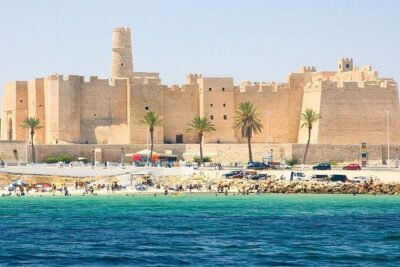
Private Tour to Kairouan, El Jem & Monastir from Tunis Hammamet
Read our review →
Half-day excursion from Sousse to the amphitheater of El Jem
Read our review →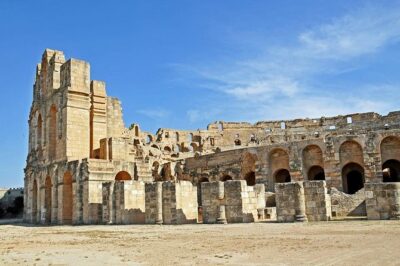
Private and Guided Tour to Kairouan and El Jem and Monastir
Read our review →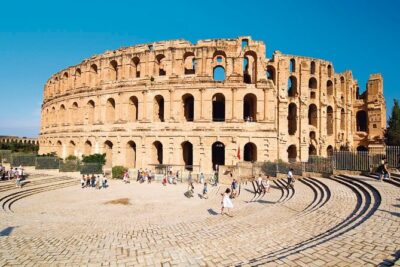
Kairouan Holy City and El Jem Colosseum Tour from Sousse
Read our review →Browse the lists this tour appears in